Skip to content
The Official Blog The Official Blog
  • Home
  • About AlertBot
  • Home
  • About AlertBot
  • FaceBook
  • X
  • Instagram
  • LinkedIn
Free Trial
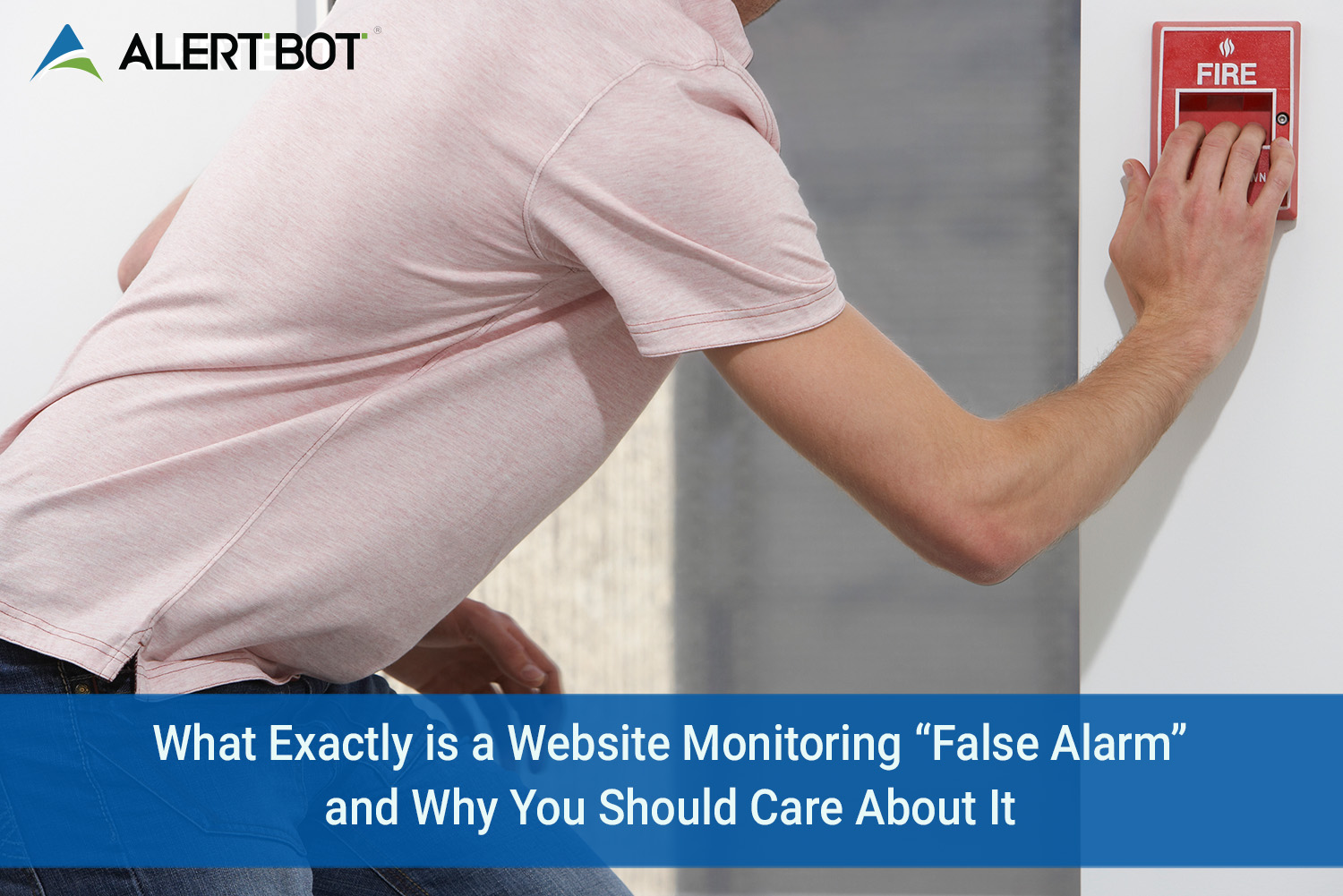
A man in a rose colored polo shirt leaning over with his hand on a fire alarm, about to depress the button.
AlertBot FeaturesEcommerce PerformanceReal Browser Website Monitoring

What Exactly is a Website Monitoring “False Alarm” and Why You Should Care About It

By AlertBot
September 28, 2021 4 Min Read
Comments Off on What Exactly is a Website Monitoring “False Alarm” and Why You Should Care About It

A man in a rose colored polo shirt leaning over with his hand on a fire alarm, about to depress the button.

What Exactly is a Website Monitoring “False Alarm”
and Why You Should Care About It

by Louis Kingston

You know what falsehoods are. You know what false teeth are. You may even know some falsehoods about false teeth. But do you know what a website monitoring false alarm (also known as a “false positive”) is? If not, then please keep reading to find out — because it’s a very big deal.

What is a False Alarm?

Remember back in grade school, when the fire bell suddenly went off in class and you were instructed to exit the class single-file and march outside? As you rose from your desk, heart racing, you wondered if you’d ever see your Trapper Keeper, Real Ghostbusters lunchbox and JanSport backpack ever again. But after you and your classmates were wrangled into the parking lot to stand in the brisk autumn air for what felt like an eternity, you soon learn it was just some older kid who thought it’d be funny to pull that shiny red lever on the hallway wall.

Well, that’s essentially what a false alarm is: a result that incorrectly indicates that a particular condition or attribute is present (i.e. it wasn’t a real fire consuming your place of education; it was merely a “false alarm” thanks to that jerk in the grade above yours).

What is a Website Monitoring False Alarm?

What you need and expect from a website monitoring tool is to know precisely when your website goes down. Why? Because research has found that the average cost of site downtime is $5,600 per minute. And remember, we are just talking about the average cost here. Some site downtime fiascos are much more costly. Just ask Amazon, which lost an estimated $99 million after going down for 63 minutes during Prime week in 2018. Granted, most businesses (including yours, unless you happen to be Jeff Bezos) won’t have to shell out $1.65 million a minute due to website downtime, but the basic point should be clear: site downtime is costly, and false alarms are supposed to minimize this financial damage.

But what happens when a website monitoring downtime alarm goes off, but nothing is actually wrong? It gets chalked up to a false alarm.

Why Website Monitoring False Alarms Are So Common

Many website monitoring tools — and virtually all of the free kind — have a test server in one location. If that test server detects that a website is not available, it does the only thing it can: sound the alarm. And that seems to be the correct thing to do, right? Well, not exactly.

Let’s say that that the website in this example is only down for a few seconds due to an isolated power outage. The test server has no way of knowing this (i.e. that the website is back up). And so, it is going to generate a false alarm.

The Solution: Multiple Testing Server Locations

Now, imagine that there are multiple test servers spread out across the country — say, one in New York and one in Los Angeles. The test server in New York detects that a website has gone down, and triggers a red alert (this test server is a big Star Trek fan). But it doesn’t sound the alarm. Instead, 60 seconds later the test server in Los Angeles checks in. If the website is up, then it cancels the red alert. If the website is down, then it confirms the initial diagnosis by the test server in New York, and the alarm goes off.

The AlertBot Advantage

At AlertBot, we hate false alarms even more than our customers. That’s why unlike many other website monitoring tools — and again, virtually all of the free ones — we have test servers located across the U.S. and worldwide. We don’t guess whether our customer’s website is down. We know.

Plus, when it is necessary to send out an alert, our system automatically and immediately contacts key people — such as network administrators, SysAdmins, CIOs, etc. — through email, SMS/text message, or phone (or any combination).

What’s more, our test servers keep checking for website site availability, and provide an update (again, in the preferred method) if it goes back up. We also highlight the amount of time that the website — or a specific portion/page of the website — was down. Our customers use this information to keep an eye on overall website performance, proactively detect problems, and ensure that their web host is consistently meeting uptime standards.

Ready to bid false alarms a true farewell? Then start a FREE TRIAL of AlertBot now. There’s no billing information required, no installation, and you’ll be setup within minutes. Click here.

Louis is a writer, author, and avid film fan. He has been writing professionally for tech blogs and local organizations for over a decade. Louis currently resides in Allentown, PA, with his wife and their German Shepherd Einstein, where he writes articles for InfoGenius, Inc, and overthinks the mythos of his favorite fandoms.


Tags:

alertsdowntimeexternal website monitoringfalse alarmfalse alertsfalse positivefeaturefeaturedsynthetic monitoringwebsite downtimewebsite monitoring
Author

AlertBot

Follow Me
Other Articles
An image of the Shire film set from Lord of the Rings that shows Bilbo's home's front door. Text on the image reads “Frodo, We Aren’t in the Shire Anymore” - The Importance of a Customer Journey & How to Avoid Wrecking It
Previous

“Frodo, We Aren’t in the Shire Anymore”: The Importance of a Customer Journey & How to Avoid Wrecking It

Graphich displaying large text that reads "AlertBot Black Friday" with smaller text that reads "Special Offer Valid November 22 thru 29, 2021. Get 20% off the life of your account! All New Accounts Get 20% off their plan! Signup now at AlertBot.com Promo Code 2021BF20"
Next

AlertBot Black Friday Deal!

Recent Posts

  • Unpacking the Elements of Site Uptime (by way of Jeopardy!)
  • API Monitoring Basics
  • Reality Bites: 7 Key Disadvantages of Real User Monitoring
  • 100% Solutions, Zero Snark: What Makes AlertBot Customer Support Superior
  • Synthetic Monitoring: Frequently Asked Questions

Recent Comments

No comments to show.

Archives

  • October 2025
  • August 2025
  • May 2025
  • April 2025
  • March 2025
  • November 2024
  • August 2024
  • April 2024
  • February 2024
  • January 2024
  • November 2023
  • October 2023
  • August 2023
  • July 2023
  • March 2023
  • February 2023
  • January 2023
  • December 2022
  • September 2022
  • August 2022
  • June 2022
  • April 2022
  • February 2022
  • December 2021
  • November 2021
  • September 2021
  • July 2021
  • May 2021
  • April 2021
  • February 2021
  • January 2021
  • December 2020
  • October 2020
  • August 2020
  • June 2020
  • April 2020
  • March 2020
  • February 2020
  • January 2020
  • November 2019
  • October 2019
  • September 2019
  • July 2019
  • June 2019
  • March 2019
  • January 2019
  • November 2018
  • October 2018
  • August 2018
  • June 2018
  • May 2018
  • April 2018
  • February 2018
  • January 2018
  • November 2017
  • October 2017
  • August 2017
  • July 2017
  • May 2017
  • April 2017
  • March 2017
  • February 2017
  • January 2017
  • December 2016
  • November 2016
  • September 2016
  • June 2016
  • May 2016
  • April 2016
  • March 2016
  • February 2016
  • January 2016
  • December 2015
  • November 2015
  • September 2015
  • August 2015
  • July 2015
  • June 2015
  • April 2015
  • March 2015
  • February 2015
  • September 2014
  • August 2014
  • May 2014

Categories

  • AlertBot Features
  • API Monitoring
  • Ecommerce Performance
  • Events
  • Industry Chatter
  • Real Browser Website Monitoring
  • Reports
  • SEO
  • Uptime Monitoring
  • Web Performance Tips
  • Website Showdowns

You May Have Missed

Real Browser Website Monitoring Uptime Monitoring

Unpacking the Elements of Site Uptime (by way of Jeopardy!)

AlertBot
By AlertBot
October 23, 2025
AlertBot Features API Monitoring Uptime Monitoring

API Monitoring Basics

AlertBot
By AlertBot
August 26, 2025
Real Browser Website Monitoring SEO Uptime Monitoring Web Performance Tips

Reality Bites: 7 Key Disadvantages of Real User Monitoring

AlertBot
By AlertBot
May 13, 2025
AlertBot Features Real Browser Website Monitoring Uptime Monitoring

100% Solutions, Zero Snark: What Makes AlertBot Customer Support Superior

AlertBot
By AlertBot
April 15, 2025
Synthetic Monitoring: Frequently Asked Questions title graphic illustration of a laptop and scientists checking graphs and charts
Real Browser Website Monitoring Uptime Monitoring

Synthetic Monitoring: Frequently Asked Questions

AlertBot
By AlertBot
March 5, 2025
Real Browser Website Monitoring Uptime Monitoring Web Performance Tips

Synthetic Website Monitoring Best Practices

AlertBot
By AlertBot
November 19, 2024
Real Browser Website Monitoring Uptime Monitoring Web Performance Tips

Three Advanced Notification Features that Your Site Uptime Monitoring Vendor MUST Deliver

AlertBot
By AlertBot
August 29, 2024
SEO Uptime Monitoring Web Performance Tips

3 Ways Site Uptime Monitoring Boosts SEO

AlertBot
By AlertBot
April 30, 2024
Graphic of a computer monitor with a frown face on the screen and x's for eyes. Clouds and spots float around, an exclamation point triangle alert symbol shows next to the monitor.
Web Performance Tips

What is a HTTP 500 Error & How Can You Fix It?

AlertBot
By AlertBot
February 15, 2024
Copyright 2026 — The Official Blog. All rights reserved. Blogsy WordPress Theme