Black Friday / Cyber Monday Showdown: Amazon vs Walmart vs Target


It’s that time of year again, where sales conscious bargain chasers brave the throngs of other sale hunters in the frigid November early morning air on that most dreaded of retail shopping days: BLACK FRIDAY. Just hours earlier, many of these same credit-card-wielding warriors were huddled around a table with family, giving thanks once again while stuffing themselves to their waistline’s discontent with mashed potatoes, roasted turkey and homemade pie. The juxtaposition of these two contradicting practices is staggering, but it’s no less the holiday tradition year after year.
As we approach another Christmas holiday, the world of ecommerce continues to ramp up the way they approach Black Friday–and its younger electronic sibling, Cyber Monday–with many now starting their sales right after Halloween. Accordingly, we decided to do something special for our next Website Showdown: a Black Friday / Cyber Monday edition that pits the ecommerce colossus Amazon against the websites for brick-and-mortar retail mega-stores Walmart and Target. It’s a truly epic battle royale to see how each site performs during the biggest shopping days of the year.
So, as usual, we used AlertBot’s external website monitoring system and its TrueBrowser™ technology to monitor all three sites from Thanksgiving through Black Friday and Cyber Monday, spanning from November 23, 2017 to November 27, 2017. We expected strong, reliable performance during the entire run and we were not disappointed. The results were nothing short of impressive.
Reliability
For the reliability evaluation of a website, we look for failure events (like when a page doesn’t fully load or it is completely down), and we look for what caused those failures.
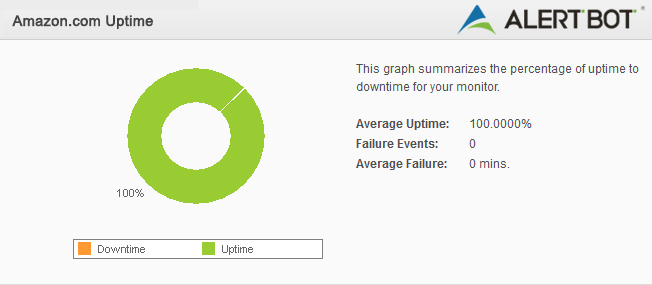
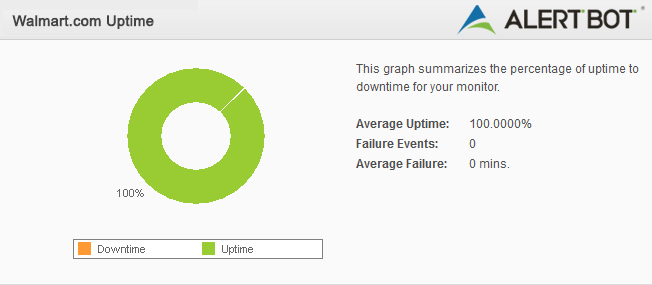
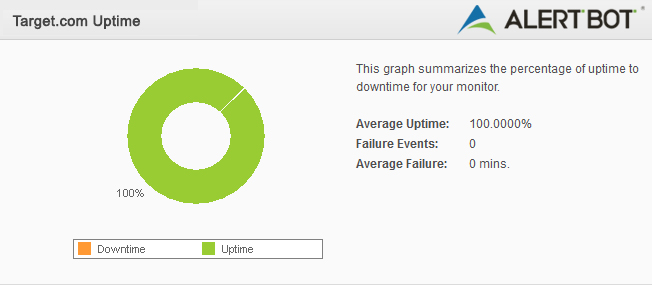
Usually for this section, we evaluate each site’s performance in detail, drilling down to specific errors each one faced, and the different types of errors we usually see (like Slow Page Files, Timeouts, etc). It’s unusual for the sites in a two-site Showdown to not return a single error, much less a three-site Showdown. In this special evaluation of three sites, not one single, solitary error was found between them. All three sites avoided any kind of failure event or significant error. With the stakes so high for three of the biggest retailers on the most significant sale days of the year, one would expect nothing less. So, with that said, each site earns a perfect score for Reliability.
(Amazon 10/10)
(Walmart 10/10)
(Target 10/10)
Speed
When evaluating a website’s speed, we look at the time it takes the site’s homepage to render and load to the point of being fully interactive by the user. These tests are performed from the perspective of a first-time visitor with no prior cache of the website’s content. AlertBot runs the tests inside real Firefox web browsers using AlertBot’s TrueBrowser ™ monitoring.
Sites like Amazon, Walmart and Target boast very graphics-driven designs, and especially with monstrous sale event days like these, the graphics are often big, bold, and frequently changing.
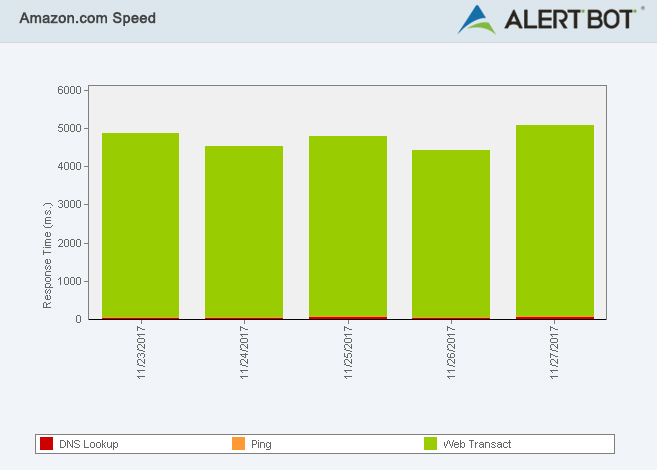
With that said, of Amazon.com’s 5-day run, they saw the fastest day, on average, to be Sunday, November 26th with 4.3 seconds. It’s not the slickest speed a site can have, but it’s certainly not bad. On their slowest day, on average, Amazon still clocked in at 5 seconds on Cyber Monday, which is still not too shabby. When looking at specific times of day for performance, the best hour was at 5AM on Sunday with an impressive 3.4 seconds, while Cyber Monday also saw the slowest hour at 7AM with 6.7 seconds.
(Amazon 9/10)
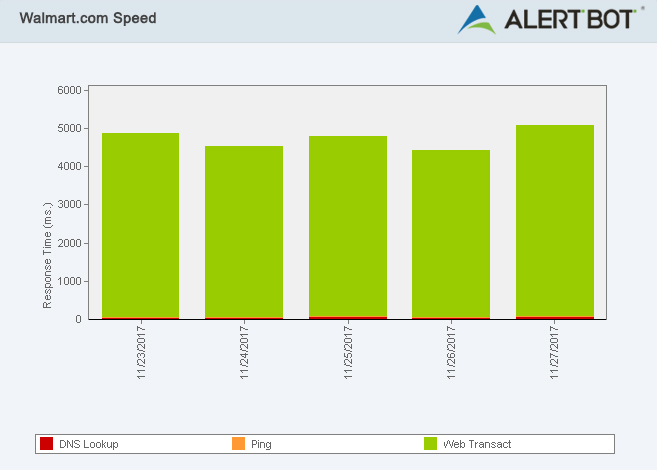
Walmart.com held their own surprisingly well during this time, too. Their best average day was Thanksgiving Day, November 23rd at 4.2 seconds, just barely edging ahead of Amazon. Their worst day on average was Saturday, November 25th, also at 5 seconds. Finally, their best hour on average was on Thanksgiving at a remarkable 2.7 seconds at 5PM. Their worst time on average was 6.4 seconds at 2AM on Sunday, November 26.
(Walmart 9.5/10)
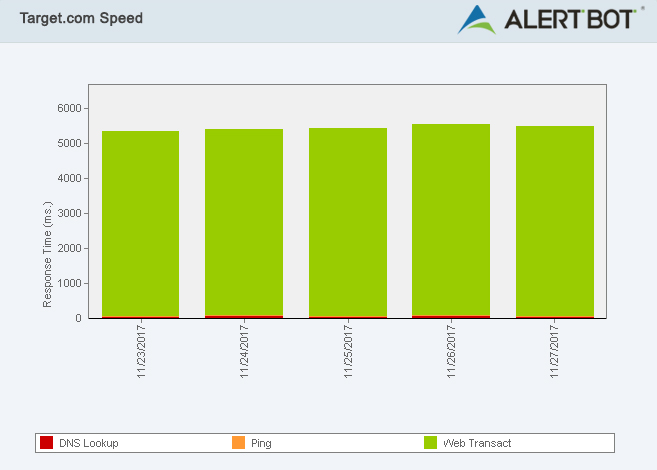
Last, but certainly not least, Target.com didn’t perform quite as well as the other two, but they still performed respectably, especially considering the fact their site avoided any failure events. Their best day for speed, on average, was Thanksgiving Day at 5.2 seconds, which is worse than both Amazon and Walmart’s worst days. Target’s slowest day on average was Sunday, November 26 at 5.4 seconds, which at the very least, shows a great consistency for the performance of the retail chain’s online presence. Their fastest hour turned out to be on Black Friday at 9AM with 3.9 seconds, with their slowest being on Cyber Monday at 4AM with 7.6 seconds.
(Target 8.5/10)
Geographic
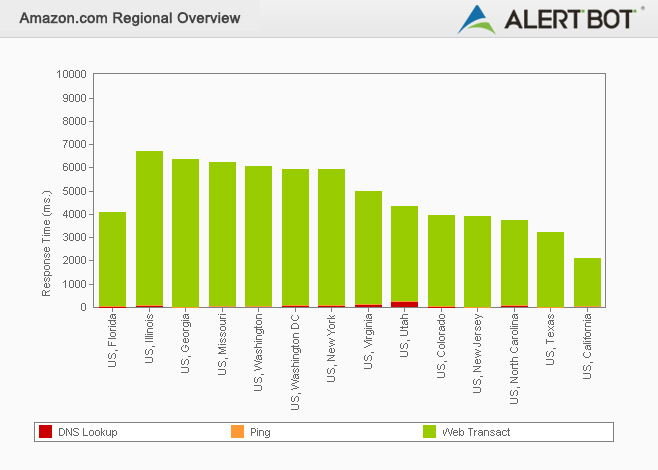
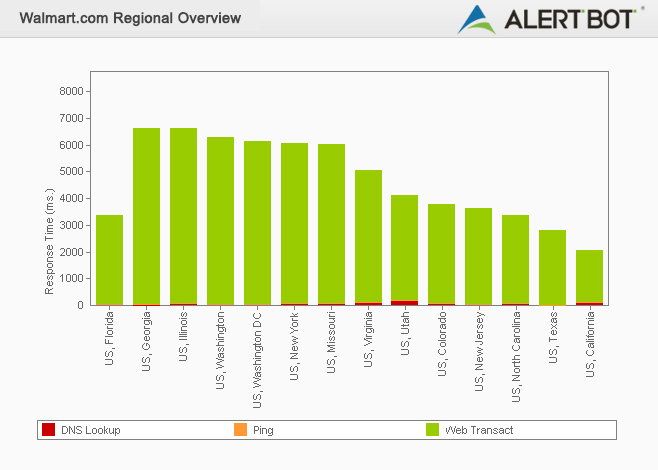
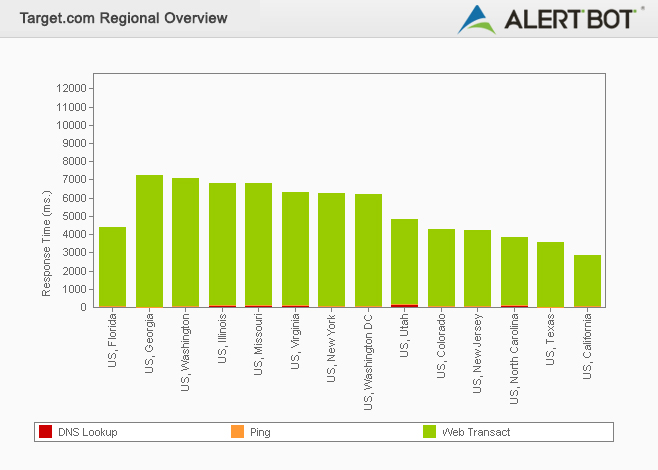
It’s always interesting to see how sites perform differently across the world. If we look exclusively at the United States, it’s intriguing to see which states regularly see faster or slower times than others.
California tends to prove to see the fastest web transaction speeds in the country, and in this test scenario, they once again come out on top for each website. For Amazon.com, the titan of ecommerce saw average load times of 2 seconds in the The Golden State, with their next-fastest location being Texas at 3.2 seconds. When it came to their slowest locations, Illinois came in at the bottom with 6.6 seconds, with Georgia just above them with 6.3 seconds.
(Amazon 9/10)
Walmart.com was only a millisecond faster, seeing an average load time of 1.9 seconds in California, also coming in faster in Texas at 2.7 seconds. But Walmart saw a placement swap for which state was the slowest, with Georgia coming in at the bottom at 6.6 seconds and Illinois right above them at 6.5 seconds.
(Walmart 9.5/10)
Target loaded on average at 2.7 seconds in California, with Texas coming in next at 3.5 seconds. Again, Target’s fastest speeds proved to be slower than their competitors. The slowest average speed that Target saw in the U.S. was also Georgia, at 7.2 seconds, but Washington stepped in as their second slowest, at 7 seconds flat.
(Target 8.5/10)
Usability
For usability, we always select a common task a user might typically try to accomplish when visiting the sites we’re testing and replicate it. For our previous Showdowns, we tested things like visiting a site for nutritional information or going through the motions of ordering movie tickets from a local theater. Like with the most recent Showdown for Lowes and Home Depot, we decided to see what the experience would be like to use these three different websites to add a common product to the shopping cart.
For each of these processes, let’s see about adding the PS4 version of new video game Star Wars: Battlefront II to our shopping cart. To begin each process, we started by opening a new tab in Google Chrome and typing in the site’s URL.
From the point of typing www.amazon.com into our Chrome browser, typing “Star Wars Battlefront 2” into the store’s search box and adding it to the cart, it took 30 seconds. From the front page, it took about 5 clicks (including selecting the autocomplete suggestion in the search bar) to get to the final “Place Order” window.
From the point of typing www.walmart.com into our Chrome browser, it took about 4 clicks and 35 seconds to get to the Cart Checkout window. The autocomplete was a little clumsy to deal with (it was tough to tell if the browser was really proceeding to load the site), but overall, it was a decent experience.
From the point of typing www.target.com into our Chrome browser, it took about 5 clicks and 27 seconds to get to the Cart Checkout window.
All three sites were good experiences, although each one has a very different feel. It’s a tough call to say which user experience we found to be better, so we decided to try a second test. This time, we chose something different, like Wonder Woman on Blu-Ray. We also decided to try Mozilla Firefox this time.
The process of finding the Blu-Ray disc and getting to the checkout process on Amazon took about 4 clicks and 25 seconds. The process on Walmart.com took 26 seconds and 5 clicks. On Target.com, it took roughly 24 seconds and 4 clicks. This time, we noticed that in the search results, there’s a convenient “Add to cart” option next to the items on Target’s site that Walmart and Amazon both DON’T have. This definitely gives Target a slight edge over their competitors. And with that being the only real significant difference, outside of its slightly faster completion time, we’ll have to say Target wins the Usability portion of this Showdown.
(Amazon 9.5/10)
(Walmart 9.5/10)
(Target 10/10)
Verdict
With stakes this high, you would only expect the best from the leaders in the retail industry, so it comes as no surprise that the results were so good and so close. This may be the toughest Showdown we’ve had to score yet, especially with three hats in the ring this time around.
But, with all things accounted for – reliability, speed, geographical performance, and the site’s usability – we’ve reached our verdict:
WINNER: