
How Site Uptime Impacts SEO (Hint: It’s a REALLY Big Deal)

 How Site Uptime Impacts SEO (Hint: It’s a REALLY Big Deal)
It is arguably the most important 3-letter acronym on the digital marketing landscape. No, it’s not ROI. It’s SEO. Consider that:
- Google processes over 5 billion searches every day.
- More than 90% of online experiences start with search engines.
- 5% of searchers click the first organic result, 15% click the second organic result, and 11% click the third result.
- 75% of searchers never scroll past the first page of results.
Clearly, effective SEO is extremely important. And for many businesses — especially smaller companies that are competing against big, established enterprises — it’s a matter of survival. However, for some decision-makers outside of the digital marketing world, the link between SEO and site uptime is less clear. Let’s fix that.
For Search Engines, it’s All About Relevance
Realtors like to point out that the three most important factors in evaluating a property are: location, location, and location. Well, the big brains behind search engines like Google and (to a lesser extent) Bing and Yahoo are obsessed with: relevance, relevance, and relevance.
What this means, is that when responding to a search query — anything from “tennis rackets” to “what’s this itchy red bump on my foot?” — search engines strive to produce results that will be seen by searchers as relevant. Otherwise, eventually searchers will switch search engine brands (e.g. leaving Google and using Bing). Relevance is the glue that keeps the relationship sticky. And unlike with those glorious model airplanes that many of us failed to create when we were kids, in this case, the more glue the better.
Downtime Damages Relevance
Since search engines strive to deliver relevant search results (and therefore positive user experience), it makes sense that downtime — which can be defined as a site being inaccessible or outright disappearing — is the enemy.
After all, if a searcher looking to buy a tennis racket clicks a site and discovers that it’s unavailable, then they won’t just punish the company that they hoped to engage: they will, in time, punish the search engine that pointed them in that direction. That fear keeps search engine folks awake at night (including mighty Google which commands more than 90% of the desktop and mobile search marketplace), and it explains why downtime is such a threat: it damages relevance.
Is 100% Uptime Absolutely Vital?
This warning about downtime begs an important question: do companies that want to stay far, far away from Google’s, Bing’s and Yahoo’s penalty box have to ensure 100% uptime? Not necessarily. While uninterrupted availability is ideal, it is not realistic. Occasionally, a site will go down for a few seconds or perhaps even longer. There are a variety of reasons for this, such as problems with a web host, an unexpected spike in traffic, and ol’ fashioned human error (hey, we all make mistaks…er, mistakes).
However, the top priority for all businesses that want to win the SEO game must be to minimize site downtime in terms of both frequency and duration. They also need to know why site downtime occurs, in order to proactively address issues and keep them from recurring. And that is where site uptime monitoring enters the picture.
What to Look for in Site Uptime Monitoring
There are many site uptime monitoring products in the marketplace, ranging from superficial (and usually free — hey, we get what we pay for), to robust and reliable. Obviously, organizations need to choose from among the latter and avoid the former. To that end, here is what to look for in a site uptime monitoring solution:
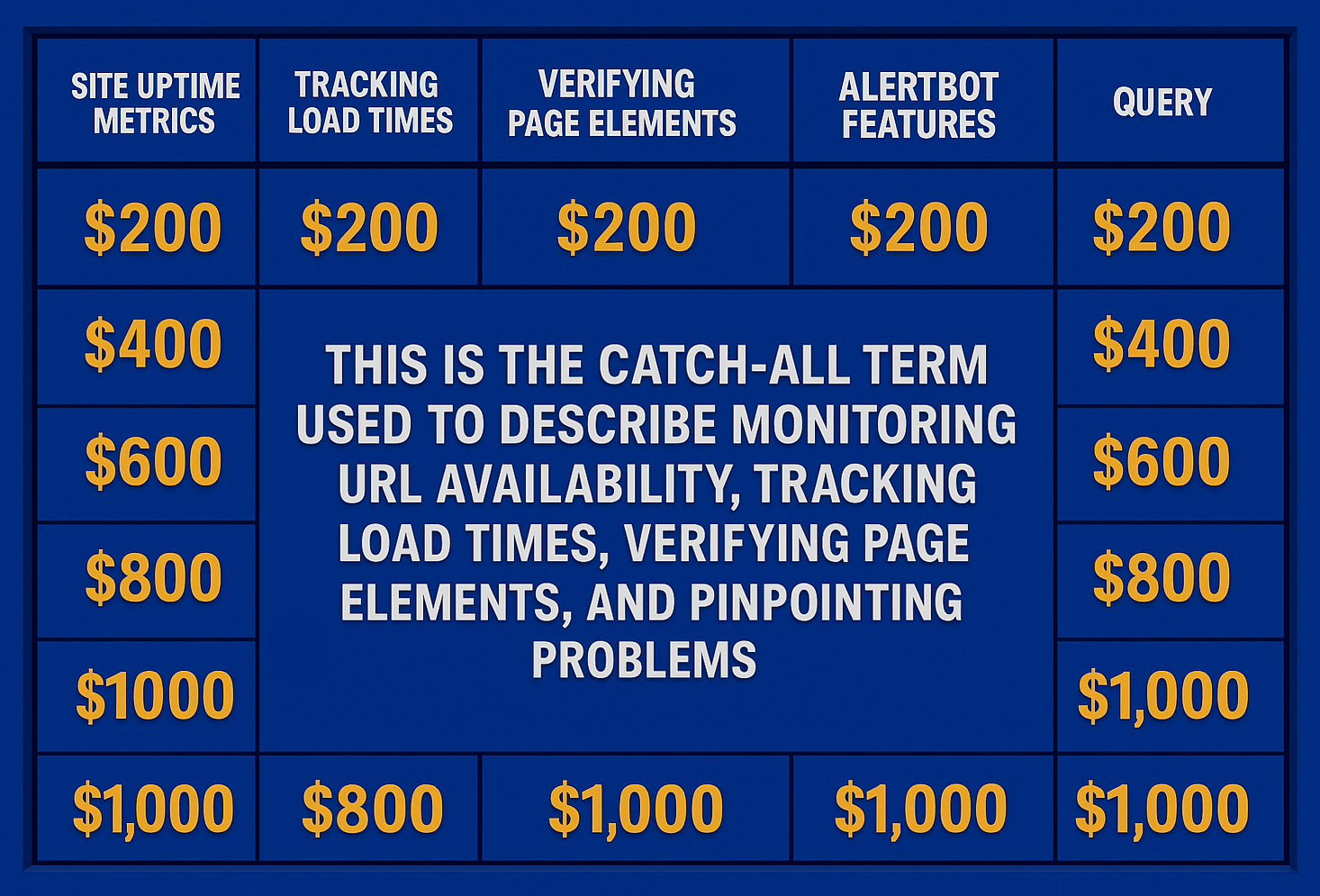
- Full site monitoring. It is not enough to monitor a site’s basic availability — because that only confirms that it exists, not that it is actually functional. It is also necessary to verify each page element, script, and interactive feature, as well as scan for errors, track load times, and pinpoint problems.
- Automated alerts delivered by phone, email and/or texts to specified individuals (e.g. CTO, IT Director, etc.), in the event of site downtime — so that the right people can take immediate action.
- The ability to record and monitor multi-step web processes with real browsers (across desktop and mobile devices), mouse clicks, and keyboard interactions.
- The ability to monitor any port on any server or device to ensure that it is up and running, including: ICMP, TCP, SMTP, POP3, IMAP, DNS, FTP, Telnet, and custom ports.
- A range of performance reports including website load times, geographic performance, failure analysis, and more.
- Ongoing monitoring from a large group of locations around the world, which is essential for avoiding false alarms and verifying that a site is truly down/unavailable.
And it goes without saying: a legitimate and reliable site uptime monitoring solution must be backed by a responsive team of experts who will immediately take ownership of an issue and see it through to resolution. This cannot be emphasized enough, because the only thing worse than site downtime is trying to get help from people who don’t know what they’re doing. It gets ugly in a hurry.
SEO is Here to Stay
The rules of SEO will change — this much is certain (Google tinkers with its algorithm hundreds of times a year). But what isn’t going to change for search engines is the supreme importance of delivering relevant results. This means effective site uptime monitoring is not an option. It is essential, and companies that fail to heed this wisdom will soon be expressing another 3-letter acronym: SOS.
AlertBot is a leading site uptime monitoring solution that checks ALL of the features and functions above, which is why it’s trusted by some of the world’s biggest brands. Start a FREE TRIAL of AlertBot now. There’s no billing information required, no installation, and you’ll be setup within minutes.